
At a Glance
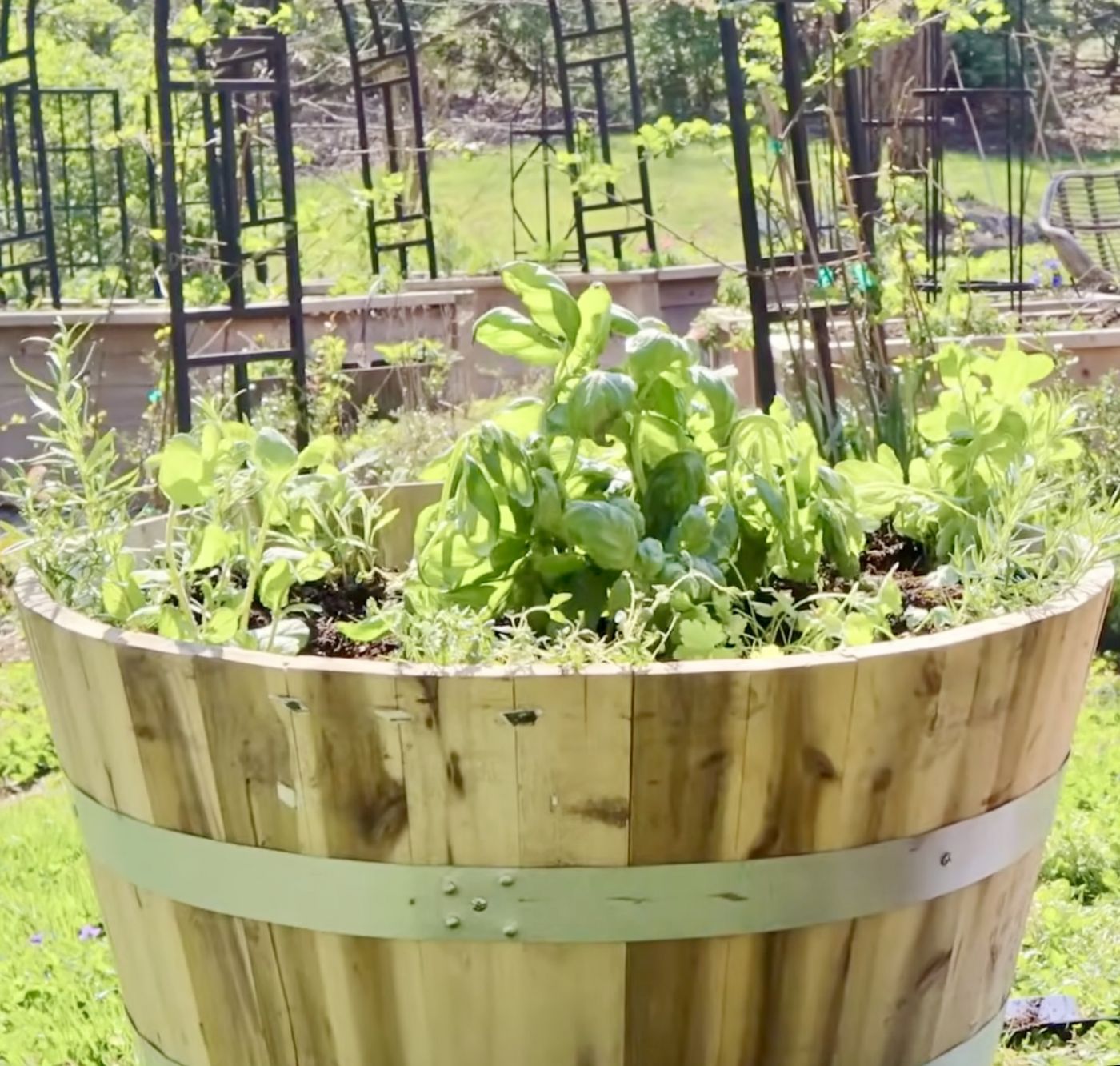
- A whiskey barrel for plants is the ideal container for a mixed herb garden. It's deep enough for healthy root development, wide enough for multiple herbs, and cool enough to become the centerpiece of any patio or deck.
- Learn step-by-step how to build and plant an herb garden from scratch.
- Our "bullseye" strategy divides the barrel into three zones based on watering needs to prevent herbs from drying out.
The Whiskey Barrel Garden: An Easy and Affordable DIY
If you've ever wanted to start a container garden but didn't know where to begin, this project is for you.
It doesn't matter if you have a tiny patio, a small budget, or zero gardening experience. A whiskey barrel garden is one of the coolest and easiest DIY garden projects you can build in a single afternoon.
By the time you're done, you'll have a stunning planter full of fragrant, organic herbs you can harvest from all season long — right outside your back door. I'll show you exactly how!
Why a Whiskey Barrel Is a Great Container for Plants
Not all containers are created equal. The whiskey barrel earns its place at the top of the list for a few very specific reasons.
The biggest mistake that ruins a container garden is buying a container that's too small. Plants need room to spread their roots, and soil needs enough volume that it doesn't dry out or lose its nutrients too quickly.
Whiskey Barrel Planter Benefits:
- Size: At over 2 feet wide and up to 2 feet deep, a whiskey barrel gives roots genuine room to stretch and soil plenty of volume to hold moisture and nutrients between waterings
- Drainage: Home Depot's whiskey barrel planters come with drainage holes pre-drilled — no extra work required
- Durability: These are built to last season after season outdoors in all conditions
- Beauty: There is simply nothing that looks quite as good on a patio or deck as a full, lush whiskey barrel planted with herbs
Gather Supplies
Full Supply List and Estimated Cost
Everything you need for this project can be purchased for a total of $100 to $115 at the time of this writing, using Home Depot for supplies and Trader Joe's for herb plants.
Supply Checklist
The container:
- Half whiskey barrel planter from Home Depot — approximately $70
Mobility:
- 3 swivel casters — approximately $15 each, about $45 total. A filled whiskey barrel for plants weighs 80 to 100 pounds. Casters are not optional — they're essential.
Drainage:
- Burlap fabric — cut into squares to cover drainage holes. Natural, biodegradable, and far better than plastic weed cloth for long-term drainage health
Soil:
- 1 bag of organic raised bed and potting mix — Kellogg's works beautifully, approximately $15 to $20
- Homemade compost if available, to fill the base and add slow-release nutrients
Herb plants from Trader Joe's (approximately $2.49 each — organic and outstanding value):
- Rosemary — 2 plants
- Thyme — 2 plants
- Sage — 1 plant
- Mint — 1 plant
- Basil — get the large multi-plant pot if available. It contains 10 to 20 plants for the same price as a single plant at a nursery. It is an exceptional deal.
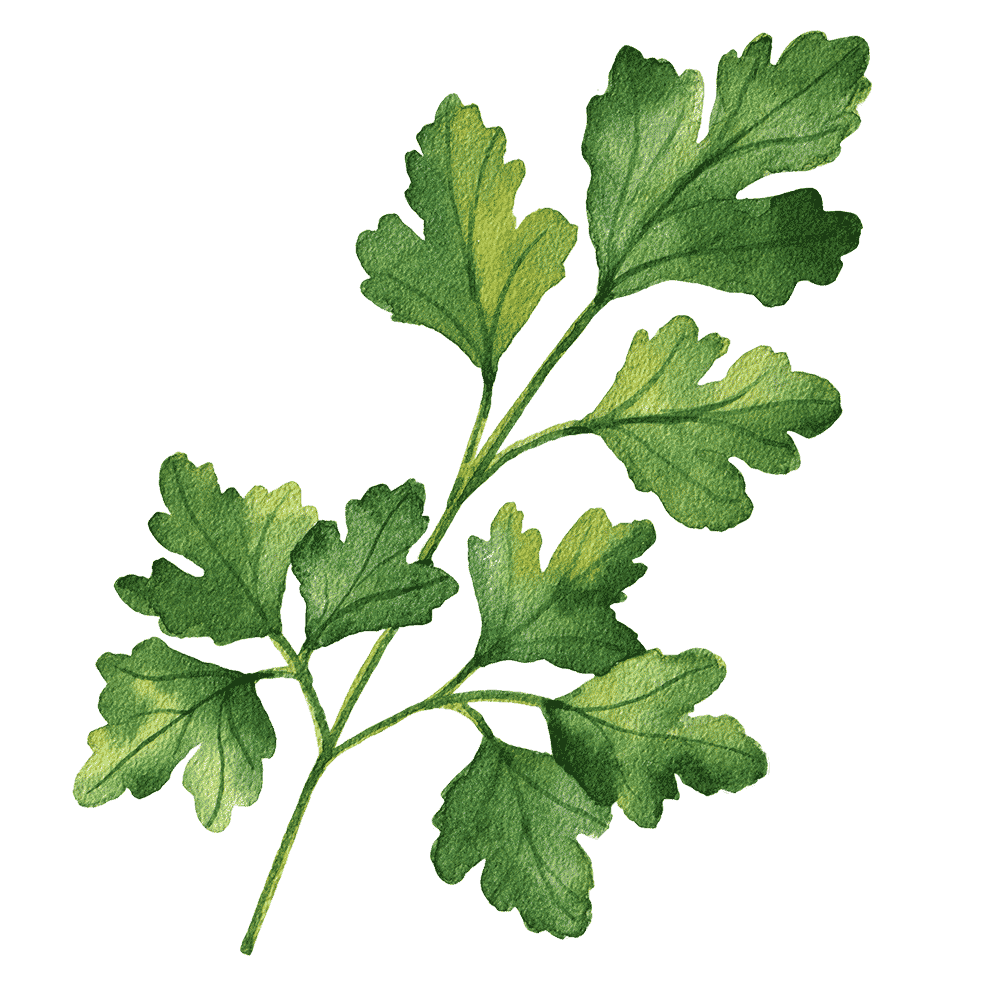
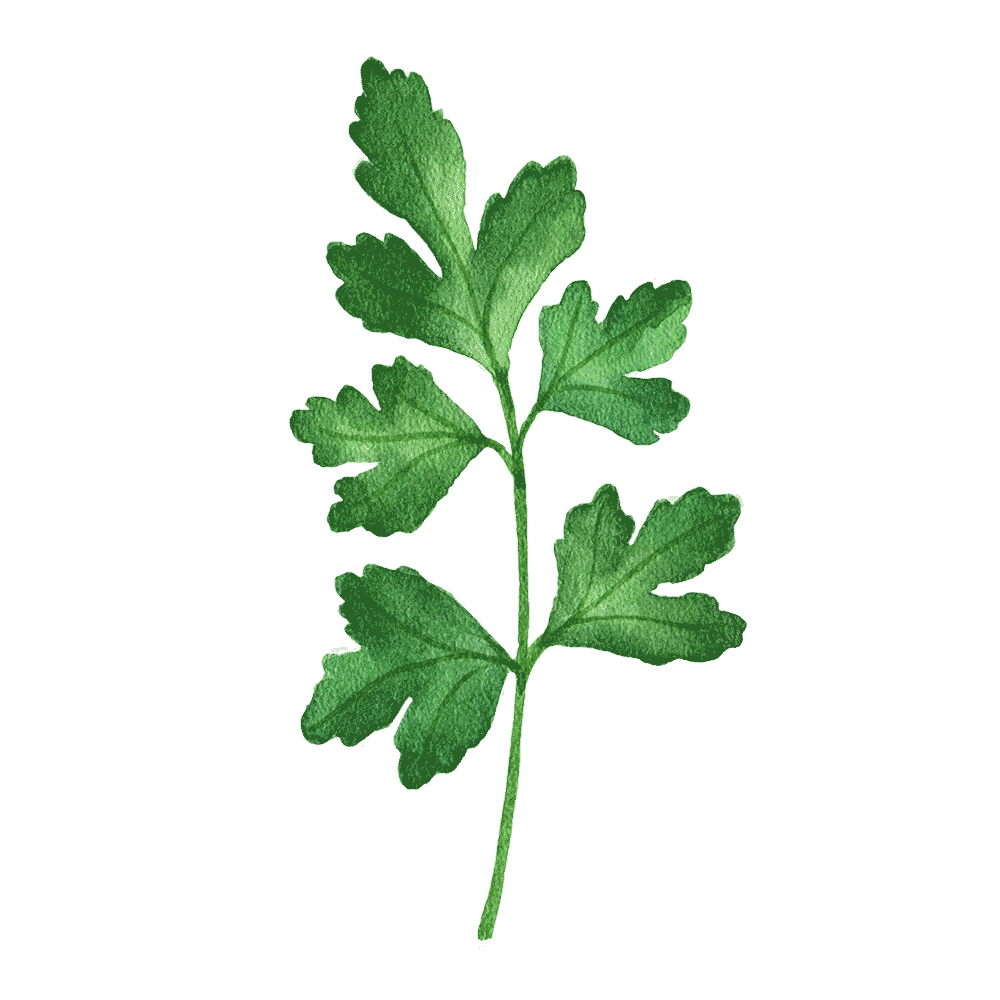
- Italian flat-leaf parsley — 1 plant
- Cilantro seedlings — optional but a great addition
Tools:
- Drill with a bit sized to match the caster bolts
- Hand trowel
- Watering can
Join the 2026 Gardening Workshop
How to Make a Whiskey Barrel Herb Garden
Step 1: Prep the Whiskey Barrel
Two things to do before any soil goes in: attach the casters and cover the drainage holes.
Attach the Casters First
This is the most tedious step in the whole project. Remember: "Worst first!" - get the worst done first, and you'll be done with it. Simply drill pilot holes, line up the bolts, and get everything secure.
Use the existing drainage holes as a spacing guide. Drill three evenly spaced pilot holes around the base, then bolt the casters on securely. Three casters give stable, smooth mobility without the extra expense of a fourth.
Cover the Drainage Holes
Cut a few pieces of burlap into squares and double them up over each drainage hole to prevent soil loss. Water flows out freely, soil stays in. Burlap is a good choice here because it's natural, biodegrades slowly over time, and never restricts drainage the way plastic materials can.

Step 2: Fill the Whiskey Barrel
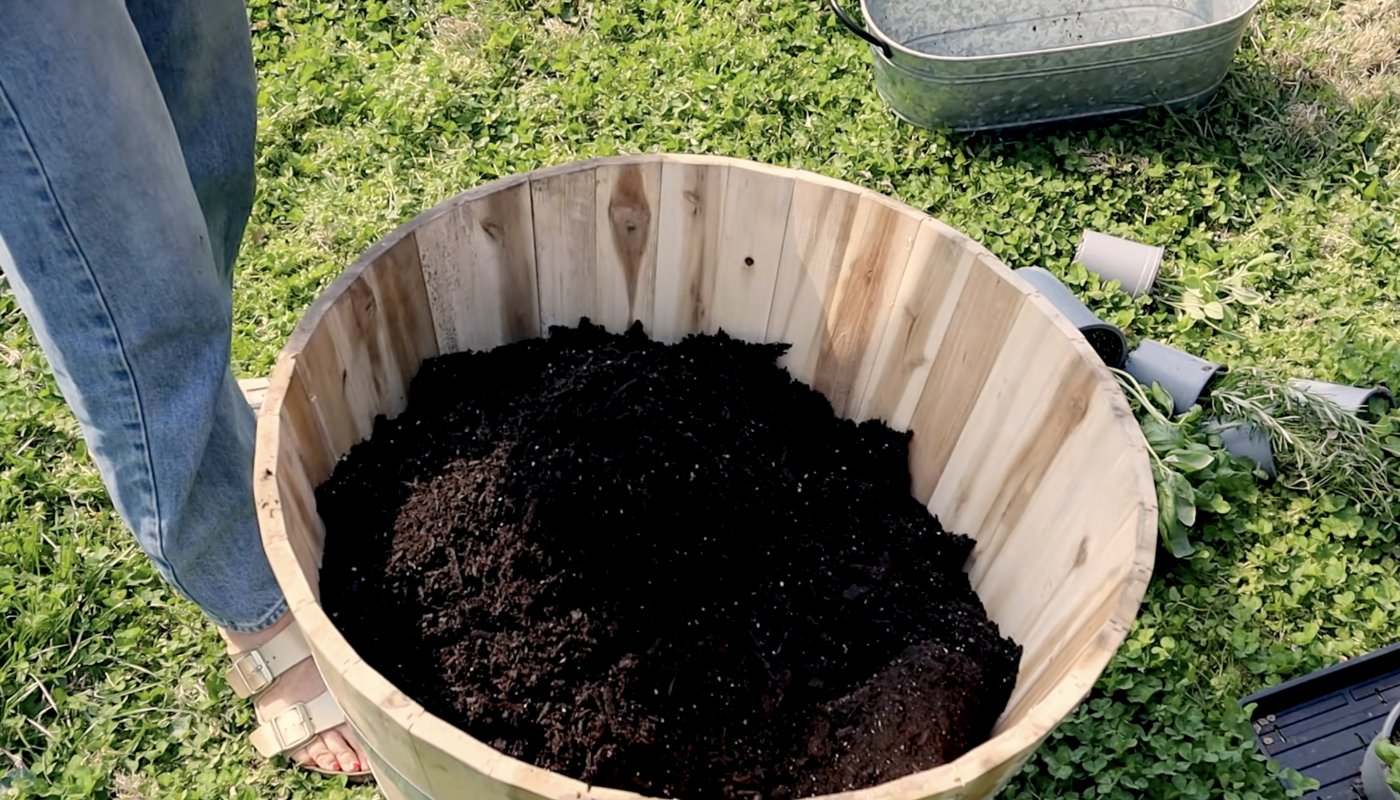
Start with a generous layer of compost at the base of the barrel. If you have a home composter, this is a perfect use for it — the compost fills volume, adds slow-release nutrients, and gives roots something rich to grow into from the start.
Next, add the biggest layer with your bagged potting mix. Then, one final layer of compost at the top. Basically, you're sandwiching your potting soil with compost layers at the top and bottom.
Give it a light blend where the layers meet using a garden trowel. Fill the barrel to a couple of inches below the rim so water has room to settle without immediately running off.

Step 3: Plant Using the Bullseye Method
Different herbs have genuinely different water needs. If you ignore that and treat the whole barrel the same way, some plants thrive, and others struggle. The bullseye method solves the problem entirely.
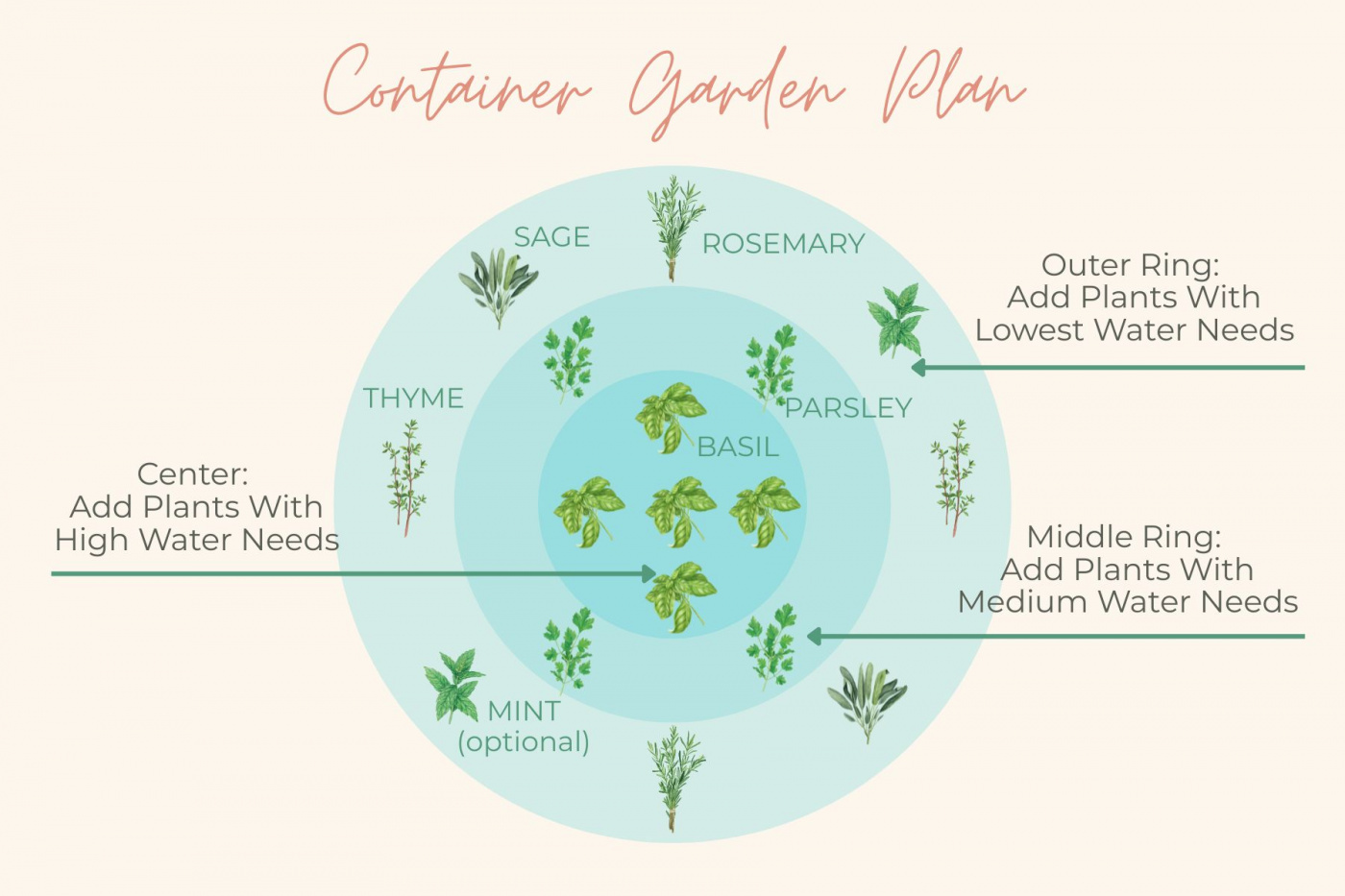
Picture a target with three concentric rings. Each ring is a watering zone. The outer ring represents the zone that gets the least amount of water because the outer part dries out fastest in containers. Every herb gets planted in the zone that matches its needs.
The Outer Ring — Lowest Water Needs
The edges of any whiskey barrel for plants dry out the fastest. More surface exposure means faster evaporation, which makes the outer ring the natural home for drought-tolerant herbs that love sun and actually prefer to dry out between waterings.
Plant these along the outer edge:
- Rosemary — plant two on opposite sides of the barrel
- Thyme — plant two in the front corners
- Sage — tuck in alongside the rosemary and thyme along the edge
- Mint — yes, mint goes here too
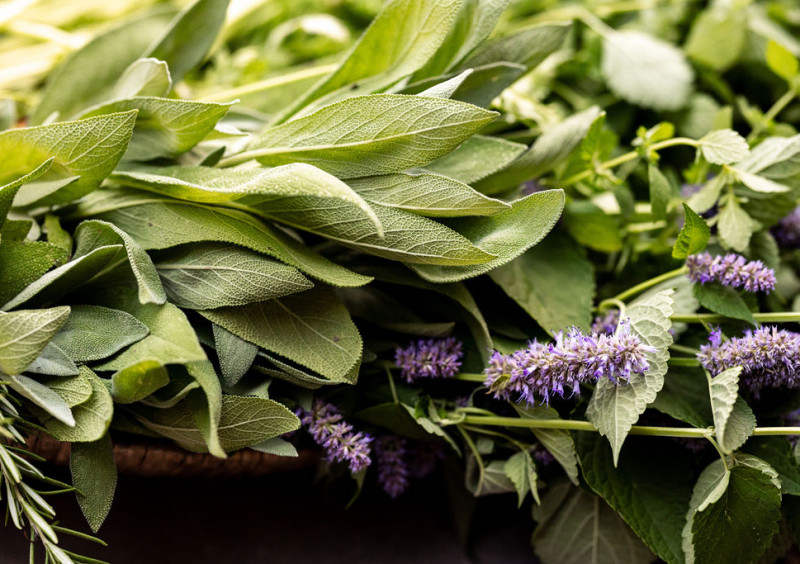
Rosemary, thyme, sage, and mint are all in the same plant family — Lamiaceae, the mint family. They share similar water preferences, similar sun requirements, and they grow beautifully together in the outer ring of a whiskey barrel for plants.
A note on mint: it's a vigorous spreader in the ground, but contained in a barrel it behaves. Its roots will travel along the bottom but it won't take over or harm the other plants within a single season. Harvest from it regularly and it stays manageable.
The Middle Ring — Medium Water Needs
Between the dry outer edge and the moist center sits the middle ring — home to herbs that want regular water but don't need the consistent moisture that basil requires. Parsley belongs here.
Parsley is in the carrot family (Apiaceae), not the mint family, which is why its water needs sit between the two extremes. Tuck it in the space between the basil and the outer herbs. It gets a bonus benefit from its position: the basil tower shades it slightly, which parsley actually appreciates since it leans toward cool-weather growing.
Other great options for the middle ring of a whiskey barrel for plants:
- Dill
- Cilantro — if you have seedlings, tuck them in here alongside the parsley
The Center Bullseye — Highest Water Needs
The center of a whiskey barrel for plants holds moisture longest — water naturally settles toward the middle as it moves through the soil. This makes the center the perfect position for basil, the thirstiest herb in this planting.
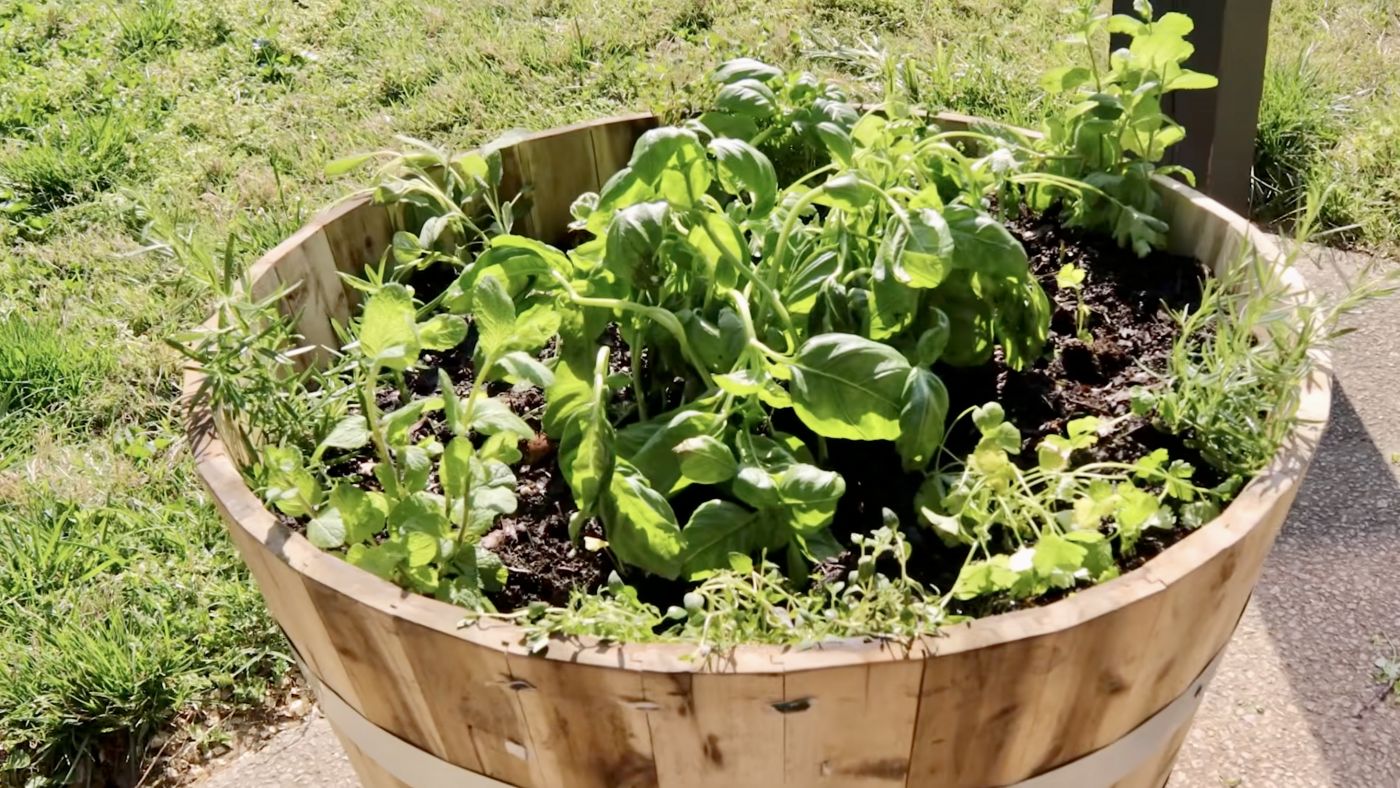
Divide that large multi-plant basil into two halves and plant one on each side of the center. The result is a basil tower — a lush, full mound of basil rising up from the middle of the barrel. It looks incredible, and it produces abundantly all season.
Basil is also the built-in moisture indicator for the whole container. The moment it starts to droop even slightly, that's your signal to water. It communicates before the situation becomes critical, which is one of the most useful things about centering it in the barrel.
Step 4: How to Water a Whiskey Barrel Herb Garden
The bullseye method makes watering a whiskey barrel for plants beautifully simple. The rule is this: water the center.
Aim your watering can at the basil in the middle. Water naturally percolates outward through the soil, reaching the middle ring herbs and then the outer ring in decreasing amounts — exactly matching each plant's needs without any extra effort from you.
Follow these guidelines:
- Give the barrel at least one inch of water per week
- Check moisture every few days by pressing a finger 2 inches into the soil — if it feels dry, it's time to water
- Never let the barrel become soaking wet — the outer herbs especially will struggle with waterlogged roots
- Watch the basil — droopy basil means the whole container needs water; happy basil means things are generally fine
- Water at the base, not overhead, to reduce fungal disease risk on the leaves
Step 5: Find the Right Spot for Your Whiskey Barrel
Here's one of the best features of a whiskey barrel for plants on casters: you can move it.
Most herbs want at least 6 hours of direct sun per day, and the casters mean you can follow the sun across your patio or deck throughout the season. Roll it into shade during an intense heat wave. Bring it closer to the kitchen door during harvest season. Tuck it under cover if a late frost threatens. The mobility transforms a heavy, fixed container into a genuinely flexible garden tool.

Ready to Build a Full Herb Garden Beyond the Barrel?
A whiskey barrel for plants is a wonderful starting point — but if this project has sparked something bigger, the Gardenary Herb Garden Guide is the most complete system available for growing herbs at home.
The guide includes two full courses:
The Homegrown Herb System walks you through everything from seed to harvest. You'll learn the five herb plant families, how to build a rolling steel herb garden, Nicole's best soil mix for herbs, and the step-by-step setup process from start to finish.
The Year-Round Herb Supply Course takes it further — covering the three keys to a successful herb garden, Nicole's exact planting and propagating process, and how to store and preserve herbs so you're using your own supply all year long instead of buying herbs at the grocery store.
Together, these two courses are the complete system for anyone who wants fresh herbs available every single day. Find the full Herb Garden Guide at gardenary.com.
Get the complete Herb Garden Guide
Alternative: Make a Flower Garden
You Don't Have to Grow Herbs — Try Flowers!
Here's something I love about this project: the whiskey barrel and the bullseye method work just as beautifully for a flower garden as they do for herbs. The container is stunning, the system is smart, and honestly, a whiskey barrel spilling over with blooms on a patio or deck is one of those things that makes people stop and ask questions.
Two rules to carry over from the herb planting: plant by watering needs and plant by height. Tallest plants in the center, medium height in the middle ring, and the shortest, trailing, or mounding plants along the outer edge.
Center Bullseye — Tall and Thirsty
The center needs height to anchor the whole planting visually and consistent moisture to thrive. These flowers earn that spotlight:
- Tall Zinnias — bold, upright, prolific bloomers that can reach 3 to 4 feet and love regular water. They become the showpiece of the whole barrel.
- Snapdragons — elegant vertical spikes in a range of colors, moisture-loving, and stunning as a center focal point
- Cleome (Spider Flower) — dramatic, tall, and airy with a long bloom season
- Tall Salvia — upright, architectural, and a magnet for hummingbirds and pollinators
- Dahlias — stunning center plants that reward consistent watering with spectacular blooms all season long
Middle Ring — Medium Height and Medium Water Needs
The middle ring bridges the height and moisture gap between the tall, thirsty center and the low, drought-tolerant edges:
- Cosmos — airy, medium height, delicate blooms that sway beautifully and don't demand much
- Calibrachoa (Million Bells) — medium-trailing habit, profuse bloomer, and sits perfectly between the tall center and low outer edge
- Dwarf Zinnias — the shorter cousins of the tall varieties, perfect for filling the middle zone with color
- Begonias — compact, tidy, and reliably beautiful with moderate water needs
- Agastache — medium height, fragrant, incredibly attractive to bees and butterflies
Outer Ring — Short and Drought-Tolerant
The outer edge belongs to low-growing, spreading, or trailing plants that spill over the rim of the barrel and frame the whole planting. These love the sun and handle drying out between waterings without complaint:
- Portulaca (Moss Rose) — practically thrives on neglect, stays very low, and trails beautifully over the barrel edge in vivid colors
- Verbena — low-growing, drought-tolerant, and comes in gorgeous purples, pinks, and reds that frame the container beautifully
- Lobularia (Sweet Alyssum) — tiny, fragrant, white or purple blooms that hug the rim and attract beneficial insects
- Creeping Thyme — yes, it flowers, and it stays perfectly low along the outer edge while handling dry conditions effortlessly
- Marigolds (dwarf varieties) — compact, sun-loving, drought-tolerant, and a natural pest deterrent right where you need it most
- Lantana — low-spreading, heat-loving, and an absolute pollinator magnet along the outer rim
Mix Herbs and Flowers Together
You don't have to choose one or the other. A whiskey barrel that combines herbs and flowers is arguably the most beautiful version of this project. Keep the tall basil tower in the center. Swap a few outer herb spots for dwarf marigolds or trailing portulaca. Tuck some sweet alyssum along the rim between the rosemary and thyme. The result is a container that's productive, fragrant, gorgeous, and buzzing with pollinators.